
Bytecrab logo
Contact Us

Patient Transportation Software Development

We build custom software for patient transport operations - from booking and dispatch to trip tracking, field updates, and admin workflows.

Patient transportation products sit at the intersection of healthcare coordination and logistics. They need to work for dispatchers, coordinators, field teams, and managers at the same time - with clear statuses, reliable updates, and workflows that reduce delays instead of creating more admin overhead.

Who this is for

Hospitals and care facilities

For discharge coordination, inter-facility transfers, and transport workflows that need better visibility and less manual work.

Patient transportation providers

For teams managing bookings, dispatching, mobile updates, and day-to-day transport operations.

NEMT operators and brokers

For scheduling, assignment logic, trip status tracking, and reporting across multiple ride types or service flows.

Healthcare teams with complex coordination needs

For organizations that have outgrown fragmented tools and need a system built around how their transport process actually works.

You're in the right place if any of these sound familiar

Every problem below came from a real conversation with a transport operator. Different countries, different fleet sizes, but the same things keep breaking. Usually because the software was picked for a different kind of business and never quite fit this one.

Generic dispatch tools bent into medical transport

Software built for taxis or couriers, awkwardly forced to handle patient workflows, safeguarding, and clinical handovers it was never designed for.

Legacy systems you've outgrown

Platforms from a decade ago that are expensive to maintain, painful to change, and slowing the operation down instead of supporting it.

Proprietary platforms with vendor lock-in

Per-seat fees, slow ticket queues, feature requests that go nowhere, and a roadmap controlled by someone else.

Spreadsheets and chat apps filling the gaps

WhatsApp groups, paper checklists, and Excel sheets quietly holding the operation together between disconnected tools.

Common problems we solve

1
Booking and intake

Trip details come in by phone, email, and chat, then get re-typed into a system by hand. The same information is often captured two or three times across different tools before the booking is fully confirmed.

2
Assignment and dispatch

Matching the right crew, vehicle, and patient requirements across many trips a day takes real coordination work. At scale, holding all the constraints in someone's head, or across a few spreadsheets is hard to do reliably.

3
Live trip visibility.

When a trip is delayed or off-plan, the control room usually finds out by calling the crew or waiting for the crew to call in. By the time the picture is clear, the next decision: re-routing, holding the next booking, or warning the receiving facility is already late.

4
In-transit care and incidents

Crews can spend hours with a patient between pickup and drop-off. When something needs to be reported - a clinical observation, an incident, a change in condition - it's often written up at the end of the shift rather than captured in the moment, which makes it harder to attach photos, timestamps, or context later.

5
Handover between facilities and transport

Every handover needs a clear record - patient condition, who handed over, who received, signatures on both ends. When that lives on paper, in photos, or in someone's notes, it's slow to retrieve and easy to lose.

6
Reporting and oversight

Operational data usually lives across booking systems, driver logs, incident notes, and finance tools. Pulling a clear picture for a given week or month means combining several sources, which takes time and slows down the feedback loop on what's actually changing.

What's inside the platform

Intake and scheduling

One place to capture every booking, with the patient and trip details recorded once and reused everywhere downstream. Cuts out the re-typing between calls, emails, and the operational system.

Assignment logic

Tools that match trips against crew skills, vehicle type, patient needs, and shift availability. Keeps complex constraints out of someone's head and into a system that can be checked and audited.

Live trip tracking

Real-time status and location for every active trip, visible to control, requesters, and managers. The next decision (re-route, hold, escalate) gets made on current information instead of a phone call.

Crew apps for the field

Tablet or mobile workflows that guide crews through pickup, in-transit care, incidents, and handover. Signatures, photos, and timestamps captured in the moment, not reconstructed at the end of the shift.

Operational dashboards

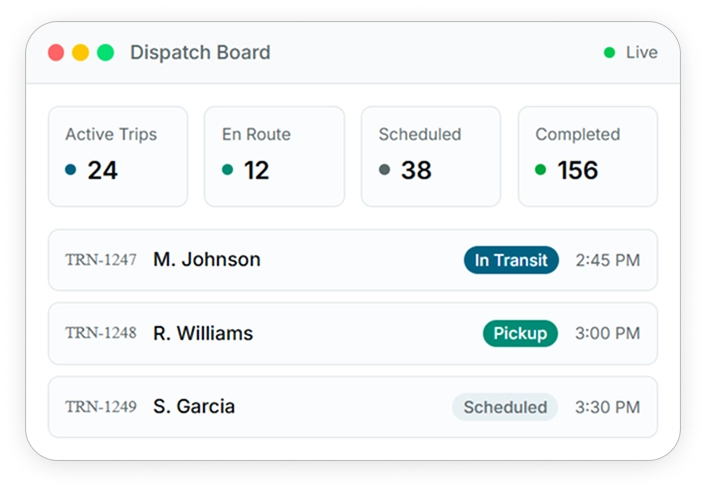
A single view for control room and managers showing what's running, what's late, what's flagged, and what needs a decision now. Replaces the patchwork of tabs, calls, and chat threads.

Alerts and notifications

SMS, email, and in-app alerts for delays, SLA breaches, incidents, and status changes. Routed to the right role so action items don't get lost in shared inboxes.

Reporting and analytics

Pre-built reports for operations, compliance, and finance, plus exports to CSV or PDF. Pulls from the same source data the team uses every day, so the numbers match what actually happened.

Integrations

Connections to EMR/EHR, billing, fleet, and notification services. Keeps the platform as one part of a wider stack instead of a tool people work around.

When custom software makes sense (and when it isn't)

Custom software is not the right answer for every transport operator. If your operation is small, runs one type of service, and works fine on a single off-the-shelf tool, building from scratch will cost more than it returns. We'll tell you that on the first call.

Custom usually starts to pay off when the operation has more than one moving part that needs to stay in sync.

Off-the-shelf is usually enough when:

  • The fleet is small and operates from one base
  • One service type covers most of the work (NEMT only, or discharge only)
  • Field crews don't need a structured app for in-transit care or incidents
  • Reporting is mostly internal and doesn't have to satisfy a regulator or broker.
  • The team is small enough that coordination happens in the room, not across systems

Custom starts to make sense when:

  • The operation runs multiple service types: secure transfers, NEMT, discharge, inter-facility, or a mix
  • Crews work in the field and need a tablet workflow for handover, incidents, and signatures
  • Compliance and audit requirements (NHS contracts, CQC, GDPR, safeguarding) need to be baked into the system, not added after
  • Subcontractors and external vendors are part of the operation and need their own access and SLAs
  • The current setup (off-the-shelf, legacy, in-house) is blocking changes the team wants to make

What we've built for operators

We build each system from the ground up, around the specific operation. The patterns below are the ones we've seen and built for most often.

Inter-facility transfers

Moving patients between hospitals, clinics, and care facilities, with clinical handover documentation, vehicle and crew matching against patient needs, and a clear audit trail from pickup to drop-off.

Coordination Documentation

Hospital discharge

Discharge runs are time-pressured and depend on coordination with ward staff. We build booking flows that connect the request, the crew, and the receiving address, with status visibility for ward managers who need to know when a bed will be free.

Workflow Handoffs

NEMT (non-emergency medical transport)

Recurring trips for dialysis, oncology, rehab, and outpatient appointments. The platform handles repeat bookings, eligibility and authorisation tracking, multi-leg routing, and the reporting regulators and payers expect.

Scheduling Compliance

Secure and mental health transport

Specialist transfers under regulated frameworks, with safeguarding workflows, automated risk scoring, two-crew assignments, and incident capture from the tablet. Built around how Secure Care UK runs 5,000+ secure transfers a year.

Mobile Real-time

Vendor-managed and brokered operations

For brokers and providers who run a mix of in-house and subcontracted transport. Assignment logic across vendors, role-scoped access for each subcontractor, SLA tracking, and consolidated reporting across the whole network.

Vendors SLAs

Where we've built systems like this before

Patient transport sits between healthcare coordination and logistics dispatch. We've shipped one production patient transport platform end to end, and we've built logistics, fleet, and dispatch systems for operators across Europe and the UK.

Lead case study Secure Care UK

A production patient transport platform, replacing a rigid third-party system

Specialist UK operator running secure patient transfers, including under regulated mental health frameworks. They had been running on a subscriber platform that couldn't keep up: bug fixes took weeks, feature requests went nowhere, and the product didn't match how they actually operated. We replaced it with two tailored systems, 136 Gateway and SCIPS, both still in daily production use.

Secure transport Mental health NHS United Kingdom Crew tablet app 24/7 operations

"Every handover and incident is now traceable, and when we need to change something, it actually gets changed. That wasn't our experience before."

Operations Lead, Secure Care UK

Adjacent logistics builds

Most of our logistics work is under NDA. The patterns below describe what we built without naming clients.

Last-mile delivery

Dispatcher console & driver app for a multi-depot operator

Real-time route assignment, live driver tracking, and exception handling across a multi-depot network in Western Europe. Replaced spreadsheet-based dispatch with a single operational view.

12+ Depots
500+ Daily routes

Courier & SLA tracking

Vehicle assignment and performance monitoring for a courier network

Shift planning, job assignment, and SLA breach alerting for a UK-based courier business. Customer-facing tracking dashboard with live ETAs and exception flags.

3 Regions
100+ Active drivers

Fleet operations

Multi-tenant fleet platform with route optimisation and shift planning

Centralised fleet management for a logistics group running operations across multiple subsidiaries. Route optimisation, driver shifts, and integrations with billing and telematics.

5+ Subsidiaries
EU Region

Patient transport is healthcare coordination on top of logistics dispatch. We've built deeply on both sides, and the same team that shipped Secure Care UK is the team that builds your project.

Project Life Cycle

Discovery

2-4 weeks

You leave this phase with a documented operational map: workflows, user roles, integration surface, and the bottlenecks worth solving first. Plus a fixed scope and a tech decision both sides have signed off on, so nothing from here on is a surprise.

Design & prototype

1-2 months

You see the system before it's built. UX flows for every role, click-through prototypes for the main journeys, and a module breakdown that maps to your operation. By the end, you've reviewed and signed off on what's going into the build.

Build

6-9 months typical

You don't wait until the end for a reveal. Working slices land regularly, demoed every two weeks, and deployed to a UAT environment where your team can work. By go-live, your team has already worked in the system and shaped it, instead of meeting it for the first time on launch day.

Launch & support

3 months included, then optional

You launch with three months of bug-fix support included, and the source code, schema, and documentation in your hands. Whether you keep us on a retainer for new features or extend the system with your own team is your call, not ours.

Integrations we commonly build

Maps, routing, and live tracking

Google Maps, Distance Matrix, and routing APIs for live trip tracking, ETA calculation, and SLA breach detection. Telematics and GPS hardware integrations when fleet vehicles are already wired up.

Notifications and messaging

Twilio for SMS, SMTP for email, push notifications for the crew tablet. Routed by role and event type, so dispatch, crew, and requesters each get the alerts that matter to them.

EMR, EHR, and clinical data

Connections to electronic medical and health records, HL7 and FHIR-based exchanges, and care coordination platforms. Scoped per integration, since each provider's API surface is different.

Reporting, billing, and exports

Scheduled exports to billing, finance, and analytics tools. CSV, PDF, and API-based delivery into systems like Power BI, accounting stacks, or regulator reporting portals.

Find out if we're the right team

Thirty-minute call. Tell us how your operation runs, and we'll tell you whether we're a fit, what a project like yours typically looks like, and what the next step would be if there's a match.

Book a discovery call

We've shipped across borders

Patient transport runs differently in every country: data residency rules, clinical handover requirements, payer and commissioner systems, language and accessibility expectations. We've shipped operational systems for healthcare and logistics teams across Europe and North America, and that experience shapes how we plan compliance, hosting, and integration work from the first call.

  • USA
  • Spain
  • Great Britain
  • Germany
  • Netherlands
  • France

FAQs

Who owns the code, data, and infrastructure?

You do. Source code, database schema, and full documentation are delivered at go-live. Your data lives on infrastructure you control, in the region you operate.

How do you handle patient data compliance?

Core primitives are baked in by default: audit trail, role-scoped access, encrypted transport and storage, PIN-locked field devices, soft-delete with full recoverability. Specific frameworks (GDPR, HIPAA, regional equivalents) are scoped per project, since each operation has its own contracts and obligations.

Can we start with one workflow and expand later?

Yes. Most projects start with the workflow that hurts most: bookings and dispatch, or crew handover, or reporting. Once that's running in production, the rest gets layered in. Scope grows with the operation, not against it.

What does pricing typically look like, and is it fixed?

Projects are scoped and priced as a fixed-price Statement of Work. Change requests during the build are quoted separately before starting, so there are no surprise invoices at the end. Ballpark figures and a more specific scope come out of the first call once we understand the operation.

How quickly can we start, and how long does the full project take?

Discovery can begin within two to four weeks of a signed agreement. End-to-end delivery (discovery, design, build, deployment) typically lands in eight to twelve months for a full operational platform, though smaller scopes ship faster.

Tell us more about yourself

Extensions: .pdf, .doc/.docx, .ppt/.pptx, .xls/.xlsx
ByteCrab in numbers
12+

years solving real-world tech challenges

150+

products shipped and scaling

20+

countries where our clients run and grow their products

USM logo Vodaphone logo Cultivist logo SecureCare logo

Project inquiries

hello@bytecrab.com

Phone number

+38 095 537 6119