
Bytecrab logo
Contact Us

Logistics and Warehouse Software Development

We build custom software for warehouse operations, dispatch, delivery coordination, and field logistics teams.

Most logistics software looks fine at the admin level and falls apart for the people doing the actual work. The picker with a scanner, the driver on the road, the dispatcher juggling twenty orders. We build the tools those people use every shift, fast enough to keep up and simple enough that nobody fights the software to get their job done.
Who this is for

Warehouse and fulfillment teams

For operations running picking, packing, stock handling, and dispatch, where the speed and accuracy of each step decides whether orders go out on time.

Delivery and transport providers

For companies coordinating deliveries, routes, and driver assignments, where one missed update means a customer is left waiting and a dispatcher is left guessing.

Field operations teams

For people working away from a desk: drivers, installers, on-site crews, who need a phone-sized tool that works in the field, not a system designed for an office screen.

Multi-site or complex operations

For businesses running several depots, warehouses, or service types at once, where the operation has outgrown spreadsheets and generic tools that were never built for this scale.

Common logistics and warehouse problems we solve

1
Receiving and putaway

Stock comes in faster than it gets logged, and items end up in the wrong place or unaccounted for. The gap between what arrived and what the system shows starts on day one and compounds from there.

2
Picking and packing

This is where most labor cost hides. Manual pick paths, double-handling, and paper pick lists slow the floor down, and the errors only show up later as wrong or short shipments.

3
Scanning, labeling, and verification

Clunky scanning tools cost a few seconds on every item, which adds up to hours across a shift. Bad labeling at this step turns into misroutes and returns downstream.

4
Dispatch and assignment

Matching orders to drivers, routes, and vehicles by hand gets unreliable as volume grows. One missed constraint becomes a re-route, a late delivery, or a truck leaving half full.

5
Delivery and field visibility

Once an order leaves the building, the office often loses sight of it. Status comes in by phone call, so the answer to "where is this order" depends on who you ask and how recently.

6
Reporting and oversight

Operational data sits across a WMS, spreadsheets, and a few inboxes. Pulling a clear picture of throughput, delays, or cost takes long enough that the numbers are stale by the time anyone sees them.

What's in the platform

Scanning and labeling

Barcode scanning for picking, packing, and verification, plus label and document generation tied to the same flow. A scan that takes a beat too long costs hours across a full shift, so this layer is built for speed first.

Inventory and stock control

Real-time stock levels, locations, and movement history that match what's actually on the shelf. The point is to close the gap between the system count and the physical count before it turns into a stockout or a write-off.

Picking and dispatch

Task assignment, pick paths, and outgoing dispatch coordinated from one place. Orders get matched to the right person, vehicle, and route without someone holding all of it in their head.

Route optimization

Delivery and collection routes planned around distance, time windows, and vehicle capacity. Cuts empty miles and gives drivers a sequence that makes sense on the ground, not just on the map.

Mobile tools for floor and field

The handheld side for pickers, drivers, and on-site crews. Built for a phone or scanner used with gloves on, in a hurry, sometimes with no signal, not for someone sitting at a desk.

Offline-ready workflows

Work keeps moving when the network drops. Scans, updates, and task completions are captured locally and synced when the connection returns, with no lost actions in between.

Operational dashboards

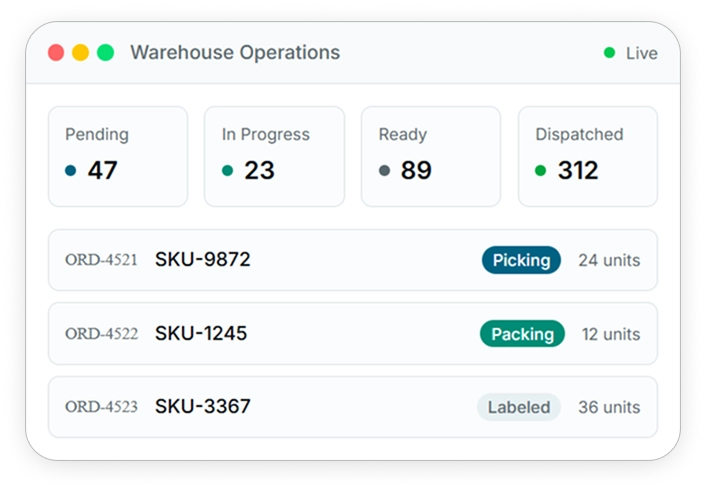
A single view for managers and dispatchers of what's in progress, what's delayed, and what needs a decision now. Replaces the round of phone calls it usually takes to find that out.

Integrations

Connections to your WMS, ERP, fleet, carrier, and accounting systems. Scoped per integration, since every operation runs a different mix and the data rarely lines up cleanly.

When custom is the right call (and when it isn't)

Custom software is not the right answer for every operation. If your process is close to standard, runs from one site, and fits an off-the-shelf WMS or TMS without much bending, a packaged tool will serve you better than a build. We say so on the first call when that's the case.

Custom usually starts to pay off when the operation stops fitting the box: exceptions become the norm, the workflow splits across roles and sites, or the current tools are holding the operation back instead of running it.

Off-the-shelf is usually enough when:

  • The process is standard: receive, store, pick, pack, ship
  • The operation runs from a single site
  • Standard scanners and hardware cover the floor
  • There's no heavy field or offline component
  • Volume is steady rather than growing fast
  • Reporting is internal and doesn't need to be custom

Custom starts to make sense when:

  • Exceptions and non-standard routines are a daily part of the work
  • The operation spans multiple sites, depots, or service types
  • Mixed or legacy devices have to be integrated, not replaced
  • Field crews need offline-capable mobile tools
  • Integration with an existing ERP or WMS goes beyond what packaged tools allow
  • The current setup is blocking changes the operation needs to make

Operations we build for

Warehouse and fulfillment

For operations moving product through receiving, storage, picking, packing, and shipping. Built for high order volume where the speed and accuracy of each pick decide whether the day stays on schedule.

Warehouse Fulfillment

Last-mile delivery

For companies getting orders to the final customer: parcel, food, retail, or service delivery. Route planning, driver apps, live tracking, and proof of delivery that hold up when the volume spikes.

Delivery Last-mile

Freight and transport

For moving goods between points: long-haul, regional, or inter-site transport. Load assignment, vehicle and driver scheduling, and visibility across a network where a delay in one leg ripples into the next.

Freight Transport

Field service operations

For teams working on site: installation, maintenance, inspection, repair. Job scheduling, mobile tools that work offline, and a clear line between what's assigned, in progress, and done.

Mobile Field

Third-party logistics (3PL)

For providers running warehousing or transport on behalf of multiple clients. Separate visibility and reporting per client, role-scoped access, and the ability to run different workflows side by side without them bleeding into each other.

3PL Multi-client

Project Life Cycle

Discovery

2-4 weeks

You leave this phase with a clear picture of the operation: the workflow across floor, dispatch, and field, the systems and devices already in play, and where the operation loses the most time. Plus a fixed scope and a tech decision agreed by both sides, so nothing from here on is a surprise.

Design & prototype

1-2 months

You see the system before it's built. UX flows for floor staff, dispatchers, and managers, click-through prototypes for the main workflows, and a module breakdown that maps to how the operation runs. By the end, you've reviewed and signed off on what's going into the build.

Build

6-9 months typical

You don't wait until the end for a reveal. Working slices land regularly, demoed every two weeks, and deployed to a UAT environment where your team can work. By go-live, your team has already worked in the system and shaped it, instead of meeting it for the first time on launch day.

Launch & support

3 months included, then optional

You launch with three months of bug-fix support included, and the source code, schema, and documentation in your hands. Whether you keep us on a retainer for new features or extend the system with your own team is your call, not ours.

Integrations we commonly build

ERP and WMS systems

Connections to the stack you already run: SAP, NetSuite, Microsoft Dynamics, or an existing WMS. Scoped per integration, since most operations run a mix of systems and the data rarely lines up cleanly between them.

Scanners, printers, and hardware

Barcode scanners, label printers, and handheld devices from the brands warehouses actually use, like Zebra and Honeywell. ZPL label printing and scanner input wired directly into the workflow, not bolted on through a separate driver.

Carriers and shipping

Label generation, rate shopping, and tracking through carrier APIs: FedEx, UPS, DHL, Royal Mail, DPD, and regional couriers. One booking flow that talks to whichever carrier the shipment needs, instead of a separate tool per carrier.

Telematics and fleet

Vehicle tracking, driver behavior, and route data from telematics providers like Samsara or Geotab. Live location and fleet status pulled into the same view as orders and dispatch, so the office sees one picture instead of two systems.

30 minute consultation

Book a consultation. Tell us about your operation, the bottlenecks, and what you're trying to fix. We'll come back with a fit check and a sense of what the project would take.

Consultation call

FAQs

Who owns the code, data, and infrastructure?

You do. Source code, database schema, and full documentation are delivered at go-live. Your data lives on infrastructure you control, in the region you operate.

Will it work with our current ERP, WMS, and hardware?

That's usually the starting point, not an afterthought. We map your existing stack during discovery: what stays, what connects, what gets replaced. Scanners, printers, and legacy systems are integrated where it makes sense, so you're not forced into a full rebuild to get value.

Can we start with one part of the operation and expand later?

Yes. Most projects start with the part that hurts most: the warehouse floor, dispatch, or field operations. Once that's running in production, the rest gets layered in as the operation is ready for it.

What does pricing typically look like, and is it fixed?

Projects are scoped and priced as a fixed-price Statement of Work. Change requests during the build are quoted separately before starting, so there are no surprise invoices at the end. Ballpark figures and a more specific scope come out of the first call once we understand the operation.

How quickly can we start, and how long does a project take?

Discovery can begin within two to four weeks of a signed agreement. End-to-end delivery (discovery, design, build, deployment) typically lands in six to nine months for a full platform, though smaller scopes ship faster.

Tell us more about yourself

Extensions: .pdf, .doc/.docx, .ppt/.pptx, .xls/.xlsx
ByteCrab in numbers
12+

years solving real-world tech challenges

150+

products shipped and scaling

20+

countries where our clients run and grow their products

USM logo Vodaphone logo Cultivist logo SecureCare logo

Project inquiries

hello@bytecrab.com

Phone number

+38 095 537 6119